
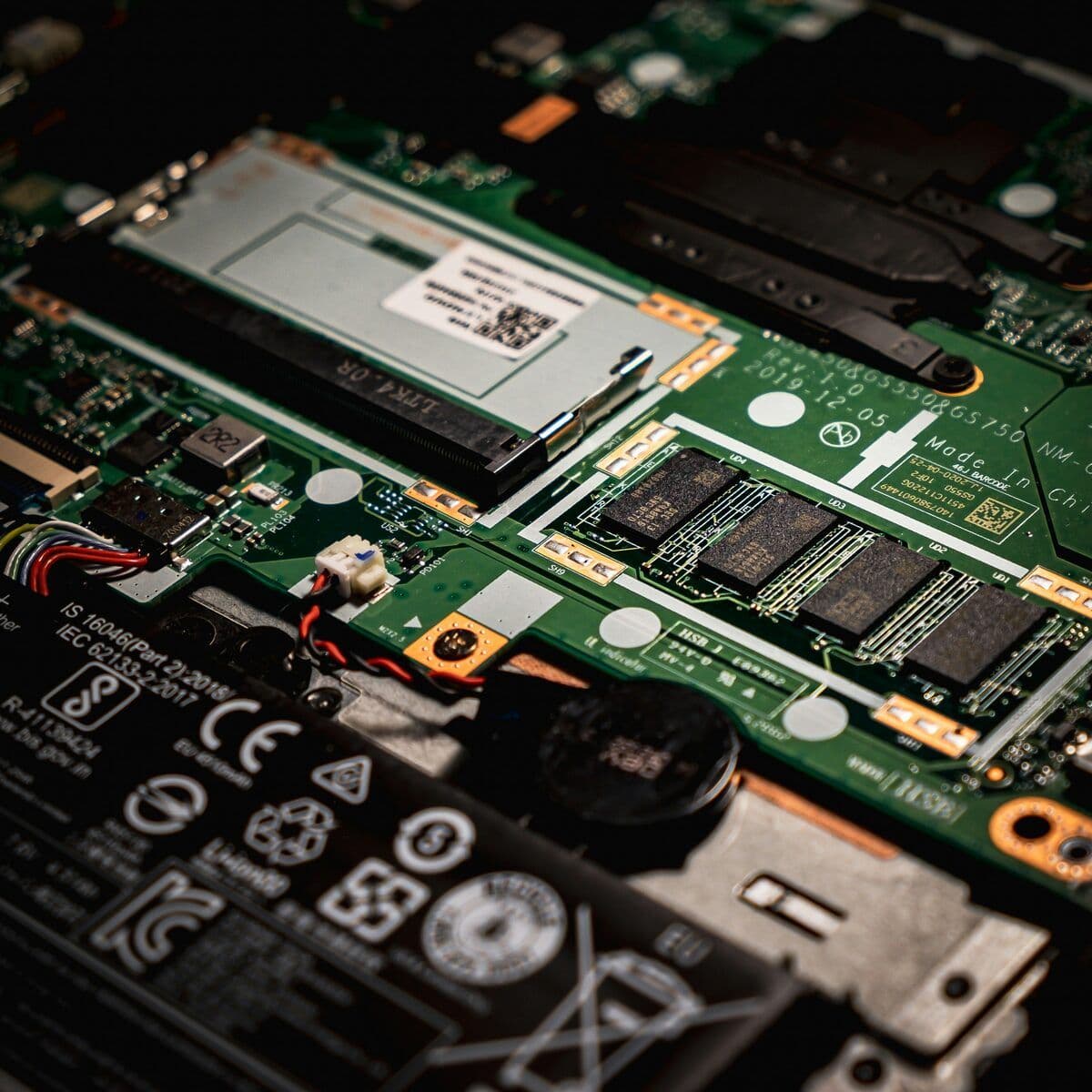
Industrial SSD vs consumer SSD
Industry's very specific requirements call for storage solutions far more robust than consumer offerings.
Durability and environmental resistance
A consumer SSD runs in a controlled environment, typically between 0°C and 70°C, with no particular optimization for shocks, vibration, humidity or dust.
An industrial SSD runs across severe ranges (-40°C to +85°C, up to +95°C on premium models), certified for shock resistance (1500G), vibration tolerance (20G across three axes), dust ingress protection and water sealing (IP67/IP68). Applications: automotive, medical, aerospace, IoT, robotics, heavy industry.
Write endurance and NAND technologies
A consumer SSD mainly uses TLC or QLC NAND, with roughly 1,000 program/erase (P/E) cycles — enough for standard office or leisure use.
An industrial SSD uses more durable NAND types — SLC, pSLC or premium MLC — pushing endurance up to 100,000 P/E cycles. Advanced wear leveling and error correction prevent premature degradation, for intensive data acquisition and continuous recording scenarios.
Data security and integrity
A consumer SSD offers basic security through software encryption to TCG Opal or AES standards.
An industrial SSD integrates secure hardware encryption, power-loss protection mechanisms, and reinforced ECC algorithms. These safeguards preserve data integrity through sudden failures — essential in military, biomedical or transport environments.
Performance and thermal management
A consumer SSD prioritizes burst performance, with sequential read/write speeds reaching 3,500 MB/s on PCIe Gen3.
An industrial SSD prioritizes long-term stability through superior active/passive thermal management and optimized firmware, ensuring minimal latency and jitter — critical for automated production lines and embedded systems.
Long-term reliability and technical support
A consumer SSD has a 3–5 year lifespan under normal conditions, with a consumer-grade warranty.
An industrial SSD is engineered for continuous operation over 7–10 years in extreme conditions, with a high MTBF (often exceeding 2 million hours). Extended technical support includes integration services, firmware updates and rapid replacement protocols.
Cost and value proposition
A consumer SSD stays affordable, with an acceptable performance-to-price ratio for home use.
An industrial SSD costs 3 to 10 times more — justified by premium components, quality certifications, mechanical ruggedness and extended operational lifespan, an investment in durability and critical system reliability.
Conclusion
Industrial SSDs meet extreme demands: wide temperature ranges, mechanical resilience, exceptional write endurance, enhanced data security and extended operational reliability that go well beyond what a consumer-grade SSD can deliver. For industrial enterprises, understanding these fundamental technical distinctions is key to choosing the storage solution that maximizes performance, security and equipment uptime.